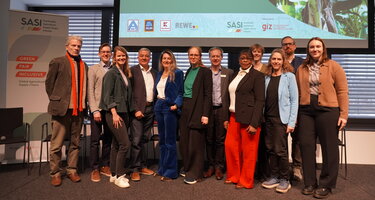
Working together in the banana sector: Panel event at Fruit Logistica 2026
SASI hosted a panel event at Fruit Logistica on “Together for Living Wages in the Banana Sector”. The event emphasized the remarkable achievements of the project, in particular the unprecedented collaboration between retailers and the trust built that have enabled cooperation along the supply chain and important sector-wide action on reducing living wage gaps amongst banana workers.
As underlined by Annika Wandscher, policy officer at the Federal Ministry for Economic Cooperation and Development (BMZ), in her keynote, public-private cooperation, sector-wide solutions and a cooperative sector-environment are essential components of long-lasting change. In this regard, the GIZ coordinates the German Retailers’ Working Group on Living Incomes and Living Wages (WG). The group, compromised of ALDI Nord, ALDI South Group, Kaufland and REWE Group, implements the project “Towards Living Wages in the Banana Sector” has not only brought together the German retailers themselves, but also diverse partners across the supply chain and beyond, particularly those of the focus project countries, Colombia and Costa Rica.
The retailers thanked all the partners involved in the project for their efforts put into it.
As part of the event, the German Retailers’ Working Group announced quantitative achievements from their Living Wage Programme 2025 for the first time: The Working Group has reached its target of 50% living wage bananas in 2025, meaning that WG retailers have each collected wage data from farms that compromise 50% of their banana volumes for the German market. Subsequently, they verified roughly 20 percent of that wage data onsite and paid voluntary contributions, proportional to volumes sourced, to any farms with existing living wage gaps. This commitment has been achieved in collaboration with more than 400 farms with over 42,000 workers across Latin America. Ultimately, the German Retailers’ Working Group is paying around 413,000 dollars in Voluntary Contributions for 2025.
Moreover, the group demonstrated advances regarding purchasing practices in general: it highlighted the collaboration with the Ethical Trading Initiative and retailers’ responsibility. In this workstream, supply chain partners are assessing anonymously the current purchasing practices of retailers and in the results retailers will be benchmarked against each other. The results will also be used to create overall guidance on purchasing practices and individual action plans for retailers.
Furthermore, the retailers highlighted the importance of social dialogue and strong national institutions and mechanisms to promote and ensure decent working conditions, including living wages, in the long run. The WG therefore collaborates with the International Labor Organization (ILO) and national labor ministries.

In the panel discussion that followed the retailer presentation similar qualitative achievements of the SASI living wage in banana project were mentioned. The panel brought together representatives of different banana supply chain levels as well as other relevant stakeholders: Panelists Carolina Jaramillo Ferrer (Uniban), Xavier Roussel (Dole), Omar Sanchez (CORBANA), Adela Torres Valoy (Sintrainagro), Alistair Smith (Banana Link) and Felix Strauss (ALDI SÜD), reflected on five years of collaboration: discussing key accomplishments, changes that occurred within project duration, past, current and future challenges and how efforts on living wages in the banana sector can be sustained and extended beyond the project which will end in summer 2027. Panelists asserted about the high level of collaboration, trust and open discussion achieved through the project, with Carolina Jaramillo Ferrer remarking that, “this project showed that utopia can become reality.” Panelists also jointly recognized that in order to sustain and extend living wages, it is necessary to engage with producing countries and the International Labour Organisation in order to strengthen social dialogue and support structural change.