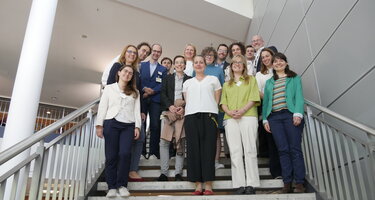
SASI and BASF in Dialogue
How can sustainable agricultural supply chains be strengthened in a changing global environment? And how can development policy and the private sector work together to create practical solutions? These questions were at the centre of a joint Partner Day with BASF hosted by the Deutsche Gesellschaft für Internationale Zusammenarbeit (GIZ) GmbH in Eschborn.
At the invitation of the Sustainable Agricultural Supply Chains Initiative (SASI), representatives from BASF and GIZ met in Eschborn in June 2026, to exchange views on common challenges and explore opportunities for future cooperation. The discussions focused on sustainable supply chains, especially for palm oil and palm kernel oil, alongside renewable agricultural raw materials and modes for partnerships in support of resilient and responsible sourcing.
As chemical company, BASF is driving the green transformation of its global supply chains. At the same time, GIZ brings together expertise and experience from international cooperation, private sector partnerships and dialogue with governments, civil society and producer organisations.
The exchange highlighted that transforming agricultural supply chains requires cooperation across institutional boundaries. Complex issues such as traceability, responsible sourcing, deforestation-free production and stable market access cannot be addressed by individual actors alone. They require dialogue, practical solutions and long-term partnerships.
Bringing together perspectives for sustainable supply chains


One focus of the discussions was the future of renewable raw materials and the question of how sustainable supply chains can be fostered to benefit both producing countries and international businesses. Palm oil was one of the commodities discussed, alongside broader opportunities related to responsible and scalable sourcing, regulatory requirements, such as the EUDR, RSPO etc. and resilient agricultural value chains. Rather than concentrating on individual commodities or countries, the dialogue explored how different actors can jointly contribute to sustainable and future-proof supply chains.
SASI contributes to this process by bringing together perspectives from governments, the private sector, civil society and producer organisations. Through its global network and local presence, it creates opportunities for dialogue, connects relevant partners and helps translate international sustainability requirements into practical approaches on the ground. This role as a facilitator and trusted intermediary is a key element of SASI’s work.
"Sustainable agricultural supply chains can only be strengthened through cooperation. SASI brings together the experience of international cooperation, the perspectives of local partners and the commitment of the private sector. Our role is to connect these strengths and create the conditions for joint solutions with measurable impact."
Building on common interests and complementary strengths
The Partner Day also identified several intersections between BASF’s sustainability agenda and GIZ’s work in international cooperation. These include, amongst others, responsible agricultural sourcing, support for smallholder farmers, the implementation of international due diligence requirements and dialogue formats that bring together different stakeholder groups.
The exchange underlined that sustainable supply chains are not only an environmental and social issue, but also an economic one. Reliable partnerships, stronger local value creation and resilient sourcing structures contribute to long-term stability for companies and producer countries alike. In this context, SASI considers itself as a platform and point of entry for cooperation with the private sector in the field of agricultural supply chains, helping to connect actors and identify suitable cooperation formats.
"The exchange between GIZ and BASF highlighted the strong potential of partnerships between business and development cooperation to combine complementary strengths and build sustainable, resilient raw material supply chains while advancing development goals."
The discussions in Eschborn marked the beginning of a close professional exchange between GIZ and BASF’s corporate sustainability and strategic procurements department. Several identified workstreams will be followed up to further examine where the respective strengths and networks of GIZ and BASF can complement each other and where future cooperation could contribute to more sustainable agricultural supply chains.
"Transforming agricultural and food systems requires cooperation across sectors. When we bring together the experience of international cooperation, the knowledge of local partners and the innovative capacity of the private sector, we create impact that goes far beyond individual projects."