From Cocoa Husks to Classrooms: How Ghana Is Turning Cocoa Waste into Opportunity
What if the waste generated from cocoa processing could be transformed into something that improves education, creates local jobs, strengthens traceability and contributes to better livelihoods for cocoa-farming communities?
By Francis Dadzie Mintah
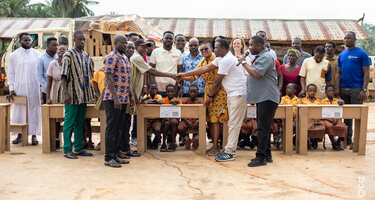
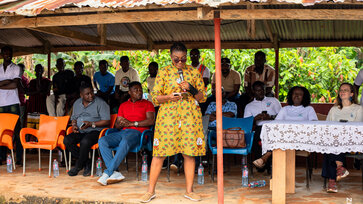
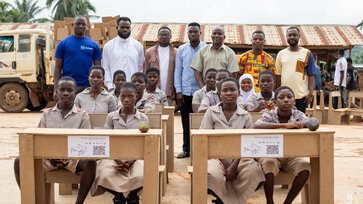
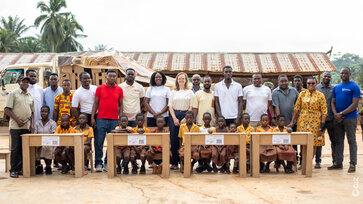
In Bukuruso in Ghana’s Twifo Praso District, that question is being answered through an innovative circular economy initiative that is turning cocoa husks into school desks and demonstrating how agricultural waste can become a resource for community development. A total of 300 school desks produced from recycled cocoa husks have been presented to students in the community, providing much-needed classroom furniture while showcasing a new approach to managing cocoa-processing waste.
From waste to a valuable resource
Cocoa is one of Ghana’s most important agricultural commodities, supporting the livelihoods of millions of people directly and indirectly. Yet the production and processing of cocoa also generate substantial quantities of biomass, including cocoa husks. Traditionally, such by-products have often been regarded primarily as waste or used in relatively low-value applications. The conversion of cocoa husks into durable materials for school furniture challenges that conventional approach. Instead of viewing cocoa husks as a product with little economic value, the initiative treats them as a resource that can be reintegrated into the economy.
With support from the Ghana Cocoa Board, each desk is linked to a digital product passport through the Ghana Cocoa Traceability System (GCTS). This means the cocoa husks used in producing the material can be traced back to the farmers and farms from which they were sourced. A student sitting on one of these desks is not simply using a piece of furniture. Through traceability, the desk can potentially tell the story of the cocoa farmer, the farm, the cocoa bean and the processing residue that eventually became part of the classroom.
Supporting the fight against child labour
In cocoa-growing communities, efforts to address child labour must go beyond enforcement and awareness. They must also address the underlying economic and social conditions that can increase children's vulnerability to labour. The provision of 300 school desks directly contributes to creating a better learning environment for children in Bukuruso. At the same time, the initiative's emphasis on value creation, local employment, traceability and farmer livelihoods connects the intervention to wider efforts to create more resilient cocoa-growing communities.
Once the recycled cocoa-husk panels were produced by the Material Innovation Centre, local carpenters were engaged to transform them into usable school desks. Circular economy solutions can generate the greatest community benefits when innovation is connected to local skills and enterprises. Rather than relying entirely on externally manufactured products, the initiative creates space for local artisans to participate in production and value addition.
Connecting sustainability with farmers' livelihoods
For cocoa farmers, improving production alone may not be sufficient to address livelihood challenges. Finding responsible ways to generate additional value from cocoa and its by-products could create complementary economic opportunities. By creating potential value from cocoa husks, circular innovations are contributing to a broader strategy of improving the economic returns associated with cocoa production.
The Sustainable Cocoa Programme is an initiative of the Federal Ministry for Economic Cooperation and Development (BMZ) and the European Union in Ghana, Implemented by Deutsche Gesellschaft für Internationale Zusammenarbeit (GIZ) GmbH.
About the Sustainable Cocoa Program
The Sustainable Cocoa Program is a joint initiative of the European Union and the German Federal Ministry for Economic Cooperation and Development (BMZ), implemented jointly by the Deutsche Gesellschaft für Internationale Zusammenarbeit (GIZ) GmbH the FAO investment center, the European Forest Institute and the Joint Research Center of the European Commission.