Towards Living Wages in Colombia's Banana Sector Closing Workshop
After three years of implementation in Colombia, the Towards Living Wages in the Banana Sector project has concluded its national implementation phase. While field activities in Colombia have come to an end, project coordination and stakeholder engagement will continue until mid-2027 under the leadership of the GIZ team in Germany, supporting the transition of ongoing processes and continued dialogue among partners.
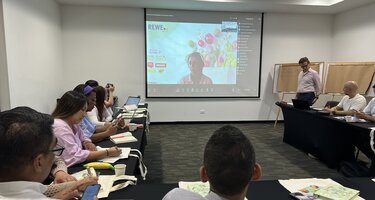
On 23 July 2026, GIZ convened the Closing Stakeholder Workshop of the project Towards Living Wages in the Banana Sector in Santa Marta, Colombia. The event brought together more than 30 participants from across the value chain, including producers, exporters, workers’ organizations, Colombian public institutions, the German Retailer Working Group, the German Embassy, the International Labour Organization (ILO), CNV International, and the World Banana Forum (WBF). Building on the March 2026 stakeholder workshop, participants reviewed progress, identified remaining priorities, and agreed on concrete next steps to sustain outcomes beyond GIZ’s technical implementation in Colombia.
The workshop emphasized Colombia’s strategic role as a key supplier to European and German markets, advocating for sustainable supply chains that integrate environmental standards, decent work, and living wages. It marked a transition from GIZ-led facilitation to greater local ownership, with project coordination from Germany continuing until mid-2027 to ensure a smooth handover. The German Retailer Working Group reaffirmed its commitment to collaboration towards living wages. Success is defined by maintaining ongoing dialogue, collaboration, and tangible actions after GIZ’s technical support concludes.
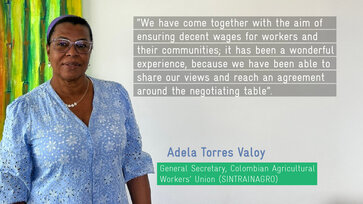
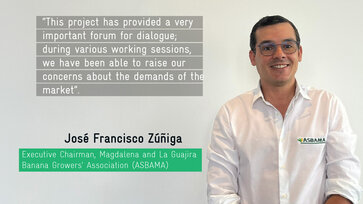
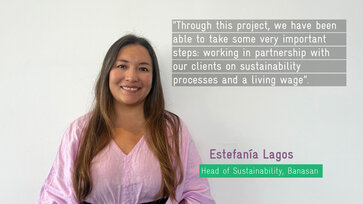
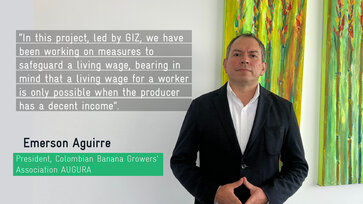
Specific progress in the project was discussed in the workshop
In the Living Wage Program (consisting of training on the IDH Salary Matrix, wage data collection & verification as well as the payment of financial voluntary contributions by retailers) significant progress was noted last year in engaging over 400 farms across Colombia, Costa Rica, the Dominican Republic, Ecuador, Guatemala, Nicaragua, and Peru. In Colombia specifically, German retailers have provided USD 231,940 to help close living wage gaps. Ongoing technical support for IDH’s Salary Matrix has been crucial, alongside the launch of tools like the Buyer Dashboard and a Voluntary Contribution Calculator to streamline retailer engagement.
In a new joint statement, retailers from Germany, the UK, Belgium, and the Netherlands reaffirmed that voluntary contributions are their responsibility and should not be shifted down the supply chain. From 2027, IDH will take the lead for the German retailers as well on wage data collection, verification, and management of the data through the new buyer dashboard. The idea of a risk-based approach for wage data collection and verification was discussed again. It aims to reduce administrative burdens by recognizing robust systems in place that already assure wage levels near or equal a living wage, e.g. collective bargaining agreements, national legislation etc. The German WG has asked the World Banana Forum to develop a first proposal for such an approach and stir conversations in the Forum.
In terms of Responsible Purchasing Practices (RPP), guidance is currently in development, with Voluntary Contribution Guidelines—including technical aspects like exchange-rate considerations—expected to be published in October 2026. The Ethical Trading Initiative has completed RPP assessments for the four German retailers and eight retailers from IDH-led living wage initiatives and 34 first-tier suppliers. The consolidated report can be found here. The German retailers are now actively developing individual action plans to improve their purchasing practices based on their respective reports.
The workshop highlighted the importance of sustaining dialogue platforms for future coordination. While GIZ has acted as a neutral facilitator, stakeholders agreed on the need for a future coordinating mechanism that possesses political credibility and independence from commercial interests. Proposals included reactivating the WBF Colombia Commission and establishing a mechanism for regular producer-retailer exchanges.
Strengthening social dialogue and decent work has been a critical element of the overall project and in Colombia. In recent years the WG collaborated with ILO on these matters. In this context, the ILO reported on their training program with 26 participants from various sectors, including employers, producer associations, companies, and unions, addressing productivity and work organization. Additionally, the Rural Labour Formalization Subcommittee was reactivated, which is currently addressing issues related to agricultural employment contracts and daily wage arrangements. Moreover, a study in Magdalena and Urabá is being designed to examine conditions for productivity, also in relation to sustainable living wages, work organization, and climate challenges. The study shall also take into account the economic context in Colombia. Producer associations reiterated the challenges the sector is facing, including macroeconomic pressures such as the 2026 appreciation of the Colombian peso and climate-related risks, including floods and El Niño variability, which have impacted productivity and profitability.
Lastly, ILO presented its Global Living Wage Programme aiming at the implementation of living wages and decent working conditions implementation through social dialogue. GIZ is exploring initial funding with European retailers to scale this up.
CNV International has focused on worker empowerment and enhancing supply chain transparency. In partnership with SINTRAINAGRO (Ciénaga), ILO, and 3F, CNV trained 19 participants so far on living wages and collective bargaining. Their approach emphasizes a participatory methodology for data collection through the Fair Work Monitor, which will involve 67 core and 86 follow-up questions covering wages, context, security, living conditions, occupational safety and health (OSH), and gender dynamics.
Overall, the workshop underscored the necessity of maintaining trust and dialogue, ensuring momentum on responsible purchasing practices, and securing a credible transition of responsibilities that promotes living wage outcomes at the farm level. With ongoing coordination from Germany until mid-2027 and a structured handover to IDH, WBF processes, and national institutions, sector partners are committed to sustaining collaboration and delivering tangible improvements for workers and businesses alike.