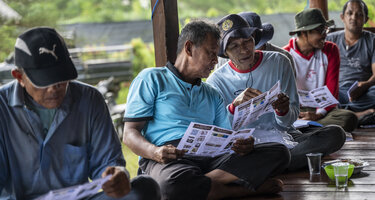
Spice hubs providing support at all levels of Indonesian pepper cultivation
The aGROWforests project is working with farmers in Indonesia to redesign pepper cultivation. To this end, so-called ‘spice hubs’ have been set up.
The world loves pepper. But the complex, cost-intensive cultivation, poor market prices and the consequences of climate change are making it increasingly difficult for farmers to continue growing pepper. This also affects Indonesia, the third largest producer of this popular spice. Verstegen Spices & Sauces,PT KGF, PT CAN, and the Dutch NGO Fairfood have been tackling these problems since 2022 and are promoting climate-resilient agriculture in Bangka Belitung and Lampung (Indonesia).
Spice hubs as places for discussion, consultation and support
Agroforestry and climate-smart agriculture are the keywords that the project participants are working with. In short, agroforestry describes a method of combining different crops and land uses to maintain biodiversity and soil fertility. This is exactly what is being taught in the ten so-called ‘spice hubs’. These are places where knowledge about climate-resilient pepper cultivation is passed on to local farmers. The hubs support agricultural change not only with intensive training, but also with very concrete assistance: they help farmers successfully bring their harvests to market.
The project is driven in particular by ‘change makers’, whom project manager Mery Ana Farida from aGROWforests describes as follows: ‘Change Makers build trust and overcome farmers’ hesitation by providing hands-on guidance, continuous support, and practical training with direct demonstration or through farmer field school approach at their farm or the Spice Hubs.’
Above all, however, the aim is for those involved to support each other. Mery Ana Farida calls this approach ‘farmer-to-farmer learning’. This concept seems to be working. For example, the farmers at the Spice Hub Centres in Namang and Pak Soleh have shown their colleagues from Jelutung a new technique for planting pepper seedlings that promises higher yields.
The path to the future
The first successes were seen very quickly. On the fields belonging to Ibu Rohelmi and Bapak Rudas, the soil quality improved in less than a year after they followed the project's advice to switch from monoculture pepper cultivation to growing other plants alongside the pepper. As a result, the pepper not only grows more vigorously than before. The couple now earns additional income from selling the other plants. ‘We used to see only pepper plants,’ says Ibu Rohelmi. ‘Now the land feels alive, full of trees, freshness and greenery.’
Mery Ana Farida still has big plans for the Spice Hubs: ‘The hope is that Spice Hubs can also become self-sustaining social enterprises, serving as hubs where farmers can access essential farm inputs from high quality seedlings to various organic inputs as well as non-farming services and financial access that improve household well-being.’ For the next phase of the project, she would also like to see high-value products such as coffee and patchouli included in the project – so that farmers can diversify their income even further.
aGROWforest is funded by the Federal Ministry for Economic Cooperation and Development as part of the ‘Initiative for Climate Smart Supply Chains’ and supported by the German Society for International Cooperation (GIZ).