24. October 2025

DryCard™ now helps rice farmers to reduce post-harvest losses

The DryCard™ is a low-cost tool that helps farmers check if dried food is safe for storage by detecting humidity levels. With support from the Fund for the Promotion of Innovation in Agriculture (I4Ag) and partners, it has now been adapted to the use with rice. This allows rice farmers to reduce spoilage, improve food safety, and protect their income.

1. Benin – Organic Transformation from the Ground Up

In Benin, the project led by Pesticide Action Network UK (PAN UK) and local partners supported farmers in transitioning to organic cotton cultivation. 

For a good harvest, it’s important to bury the plant residues in the soil – they become fertiliser. Our soil shows that we farm organically,” says Rosaline Okou, a cotton farmer from southern Benin. 

The initiative encouraged exchange among producers and laid the foundations for a growing organic cotton movement in the country.

­

2. Tanzania, Zambia and Côte d’Ivoire – Voices from the Cotton4Impact Project

Under the leadership of Paul Reinhart AG, together with Alliance Ginneries Ltd (Zambia and Tanzania) and Ivoire Coton, the project explored new ways to strengthen knowledge, transparency and traceability in the supply chain. More than 1,200 producers were interviewed to understand what has changed. 

Thanks to Ivoire Coton, I was able to build a house and send my children to school,” reported one farmer from Côte d’Ivoire. 

Through advice and better prices, I was able to buy my own farm,” shared a female farmer from Tanzania. 

Nine out of ten respondents stated that their quality of life had improved – through higher prices, better farming methods or reduced costs. However, the survey also revealed structural barriers: high input costs, delayed deliveries and limited access to finance. Producers made it clear that true sustainability can only be achieved through reliable partnerships. Cotton4Impact has established a digital exchange and learning platform to improve communication between smallholder cotton farmers and the ginnery.  

­

3. Côte d’Ivoire, Mozambique and Zambia – CAR-iSMa and the Power of Collective Innovation

The project CAR-iSMa (Climate Adaptation and Resilience in Sustainable Management of Cotton), implemented by the Aid by Trade Foundation and partner companies in three countries, aimed to strengthen soil fertility, promote biodiversity and connect knowledge across regions. 

I wanted to show that you can achieve better yields when you care for the soil,” says João Aquibo, a cotton farmer from Niassa Province, Mozambique. 

João tested compost and biochar, experimented with intercropping and achieved twice his previous yield. He now shares his experience with his neighbours – an example of how local innovation can drive change. Teams from Mozambique and Zambia exchanged experiences and developed training materials. 

Such encounters build trust and show that equal knowledge exchange is the foundation of resilience,” explains a trainer from Zambia.

­

4. Côte d’Ivoire, Togo and Chad – Cooperation for Greater Resilience

Together with Solidaridad West Africa and OlamAgri, farmers and local cooperatives worked to strengthen their resilience to climate and market fluctuations. This included sustainable agricultural trainings and sensitisation on environmental and social issues such as child labour. The project supported the establishment of savings and loan associations to improve access to finance and encourage alternative income-generating activities beyond cotton.

For a good harvest, it’s important to bury the plant residues in the soil – they become fertiliser. Our soil shows that we farm organically

Rosaline Okou, a cotton farmer from southern Benin

Across all four projects, more than 250,000 cotton producers were reached through project activities.

  • Financial self-organisation: Over 500 Village Savings and Loan Associations (VSLAs), primarily led by women, provided microcredits and enabled members to manage their own investments and diversify their income.
  • Agroecological learning: Through Farmer Field Schools and demonstration plots, producers learned from one another, experimenting and sharing practical experiences.
  • Soil health: Compost, biochar, crop rotation and regenerative methods reduced the use of chemical fertilisers and strengthened local food security.
  • Digital transparency: Mobile apps for traceability made supply chains more transparent and supported information flow to farmers.

In Benin, a second phase of the organic cotton project has begun; the CAR-iSMa network is sharing its materials with other Cotton made in Africa partners; and Cotton4Impact is using the data collected to improve supply chain practices further.

When producers, local businesses and international partners act together, a new kind of collaboration emerges – one that moves beyond “support” towards partnership, participation and mutual learning.

The stories of Rosaline, João and Jennifer stand for thousands of others – showing that transformation in cotton production begins where voices are heard and experiences are shared.

In many parts of the world, farmers and traders face a persistent challenge after harvest: keeping crops safe from mold. Grains, beans, nuts, and dried fruits may appear dry to the eye, but hidden moisture can create the perfect conditions for mold to grow. This not only leads to lost foodstuff but can also result in the development of harmful toxins that pose serious risks to food safety and health.

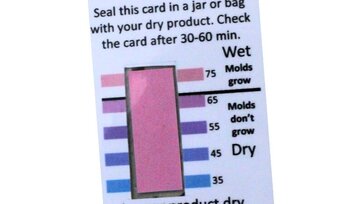
The DryCard™, a simple yet impactful invention developed by the University of California, Davis, offers a practical solution to this problem. Designed to be low-cost and easy to use, the DryCard™ allows farmers, traders, and food processors to determine whether a food product is truly safe for storage. The card contains a humidity-sensitive indicator strip that changes color based on moisture levels. When the strip turns pink, it signals that the product is still too moist and at risk of mold. When it turns blue, the product is dry enough to be safely stored. To use the card, one simply places a sample of the dried product and the DryCard™ together in a sealed jar or bag, waits between 30 and 60 minutes, and then checks the result. 

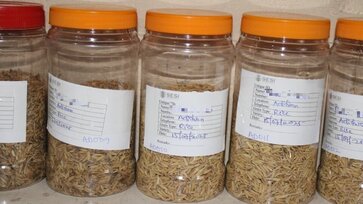
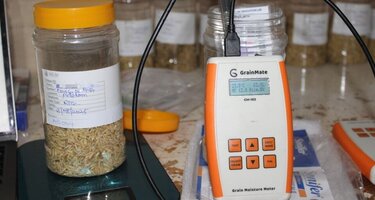
Until now, the DryCard™ could not be used accurately to determine the moisture level of rice. But with i4Ag support, the DryCard™ has now been adapted to provide reliable readings for rice. This development means rice farmers in countries like Ghana and Kenya can now use the card to determine exactly when their harvest is safe to store. To calibrate and validate the DryCard™ for use with rice, grain samples were collected from smallholder farming communities across two agro-ecological zones in the Ashanti region of Ghana. These samples were then dried to specific grain moisture levels and subsequently used to calibrate the cards' color scale for rice.

The project, implemented together with the private sector partner Saving Grains 301 GmbH and local training providers and research institutions, provides training on improved post-harvest management practices to farmers and aggregators. This includes the use of hermetic storage bags, innovative drying technologies and moisture content control.

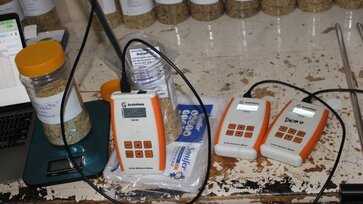
Because the DryCard™ is inexpensive, reusable, and easy to understand, it is especially useful in rural areas and places where access to costly electronic moisture meters is limited. It empowers farmers and traders to make informed decisions about storage, helping to reduce post-harvest losses and protect both food quality and livelihoods.

Now adapted for use with rice, the DryCard™ is ready to make a meaningful impact in Ghana, Kenya and around the world. Its simplicity, affordability, and effectiveness make it a powerful example of how small innovations can lead to significant improvements in agricultural resilience and food security.
This project is part of the Sustainable Agricultural Supply Chains Initiative (SASI). The SASI promotes green, fair and inclusive agricultural supply chains. Together with politics, business and civil society, it puts sustainability issues on the agenda and shapes the political discourse. The initiative is implemented by GIZ on behalf of BMZ.