Turning the Tide: Ghana Strengthens Global Efforts to End Child Labour
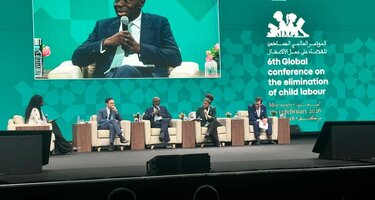
The Sustainable Cocoa Program participated in the 6th Global Conference on the Elimination of Child Labor in Marrakesh, Morocco, and presented approaches to combating child labor in the cocoa sector. With the Marrakesh Framework Plan, the conference provided new impetus for the global fight against child labor until 2030.
The Sustainable Cocoa Programme-GIZ was represented at the 6th Global Conference on the Elimination of Child Labour in Marrakech, Morocco. The SCP was represented by Richard Biney, the Child Labour expert for the Programme, Simon Crown, Deputy Director of Ghana Cocoa Board and Akosua Daah Agyente, Deputy Manager of Ghana Cocoa Board. The conference was held from the 11th to 13th February, 2026 and convened governments, international organizations, workers’ and employers’ organizations, civil society, and youth representatives to renew global efforts to end child labour in all its forms. The conference provided a critical platform to review progress toward Sustainable Development Goal Target 8.7 and to agree a renewed global roadmap to accelerate action beyond 2025.
GIZ Engagement and Contributions:
At side events, the team from Ghana had the opportunity to present our work on the Cocoa Sector Child Labour Monitoring System (CLMS) and Community Risk Assessment and Estimation approaches. These presentations highlighted the importance of data-driven monitoring and community-focused risk assessment tools in preventing, identifying, and responding to child labour in the cocoa supply chain.
Key Commitments and Resolutions from the conference:
1. Adoption of the Marrakech Global Framework for Action Against Child Labour
Participants unanimously adopted the Marrakech Global Framework for Action, reaffirming collective commitments to:
Strengthen implementation of international labour standards, especially ILO Convention No. 138 and ILO Convention No. 182.
Expand universal access to quality education as a core prevention strategy.
Strengthen social protection systems to reduce economic pressures that drive child labour.
Promote decent work opportunities for adults and youth.
Enhance data systems, accountability, and multi-sectoral coordination at global, national, and community levels.
Address emerging challenges, including child labour in informal and rural sectors.
2. Renewed Pledges and Partnerships
Governments, social partners, development actors, and the private sector made new collective pledges to scale evidence-based interventions, strengthen monitoring and remediation systems, and ensure meaningful engagement of children and communities in programme design and evaluation.
3. Accountability and Monitoring
A key resolution called for stronger national and regional monitoring mechanisms, interoperable data platforms, and periodic public reporting on progress toward ending child labour.
Outlook
The 6th Global Conference on the Elimination of Child Labour marked a strategic turning point in global efforts. While acknowledging that the 2025 target has not been met, the Conference demonstrated renewed political will through the adoption of the Marrakech Framework for Action. The emphasis has shifted from commitments to implementation, accountability, financing and measurable impact, particularly in high-risk sectors such as agriculture. Sustained collaboration among governments, employers, workers, international organizations and supply chain actors will be critical to achieving meaningful reductions in child labour by 2030 when the next Global Child Labour Conference will be held.
About the Program
The Sustainable Cocoa Program is a joint initiative of the European Union and the German Federal Ministry for Economic Cooperation and Development (BMZ), implemented jointly by the Deutsche Gesellschaft für Internationale Zusammenarbeit (GIZ) GmbH the FAO investment center, the European Forest Institute and the Joint Research Center of the European Commission.