Anchored in Practice: SASI Stakeholder Meeting on Global Agricultural Supply Chains
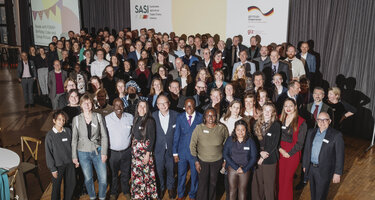
At the annual meeting on global agricultural supply chains, more than 120 representatives from business, civil society and politics exchanged views on best practice examples, challenges and new approaches. Even though there is still a long way ahead, sustainable practices are already finding their way into ever more agricultural supply chains.
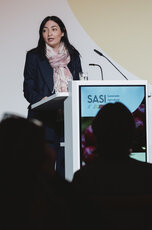
Reem Alabali Radovan
An article by Jan Rübel and Dominik Reitermann
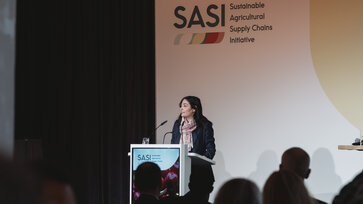
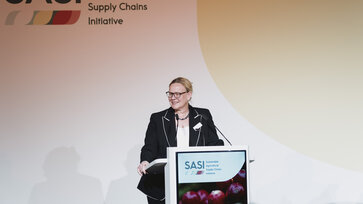
The welcoming speaker quickly gets to the point. ‘Human rights violations along supply chains show the challenges,’ says Reem Alabali Radovan to the audience. ‘As minister, I condemn this.’ The participants in the Loewe Saal listen attentively. ‘As partners of SASI, you are aware of this,’ continues the Federal Minister for Economic Cooperation and Development (BMZ), ‘it's not about products, it's about people’.
It is not as if Alabali Radovan needs to appeal to the conscience of her audience. The stakeholders gathered here in Berlin's district Moabit are well versed in how to make global agricultural supply chains sustainable. Thus, the Federal Minister sets the tone for the next two days: ‘SASI implements ideas effectively. We can create opportunities – real win-win situations!’
The stakeholder meeting of the Sustainable Agricultural Supply Chains Initiative (SASI), funded by the BMZ and implemented by the Deutsche Gesellschaft für internationale Zusammenarbeit (GIZ), is therefore all about action. Last year, the long-standing Initiative for Sustainable Agricultural Supply Chains (INA) was expanded and renamed as Sustainable Supply Chains Initiative (SASI). Today's event is not only about sharing the experiences of past years, but also about strengthening existing partnerships and initiating future cooperation.
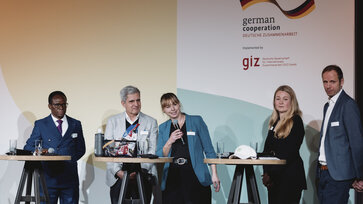
In the first panel, past progress is illustrated with a basket full of sustainable products. Representing the commodities coffee, cocoa, palm oil and cotton, four representatives of the private sector are joining Paul Garaycochea and Ina von Frantzius, both part of the BMZ, on stage. ‘Our goals are responsible purchasing strategies,’ says Alina Tremmel from the Lidl Foundation, who is a member of the German Retail Working Group on Living Incomes and Wages in sustainable coffee supply chains. ‘We promote resilient smallholder farms, always with gender equality in mind.’ This is beneficial for all involved, ‘we also do this from the heart.’ Nico Briskorn from VfL Wolfsburg outlines what a flagship project looks like. The CSR manager of the Bundesliga football club reports on how the club fan shop is continuously expanding its repertoire with sustainably produced textiles. ‘We are convinced that fair production fits in with our fan culture,’ he says. ‘Both are based on passion.’ Fans who buy sustainably are given a story. And this story can be passed on, spreading the message of sustainable supply chains.
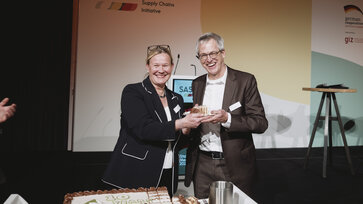
Just as Briskorn talks about the From Field to Fanshop initiative, Almut Feller reports on progress in the palm oil sector. As chairwoman, she represents the Forum for Sustainable Palm Oil (FONAP) at the stakeholder meeting, which is celebrating its tenth anniversary today. ‘Palm oil remains the most effective vegetable oil,’ says Feller on behalf of the forum's 55 members. ‘No palm oil is not a solution either.’ What began as a vision with FONAP is now a strong alliance. ‘Certification has become the norm for many products in Germany.’ But true Due Diligence goes beyond certification. ‘Sustainable supply chains for palm oil cannot be created by the private sector alone.’
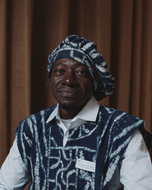
Benoit Anselme Teizem Sonkeng
Benoit Anselme Teizem Sonkeng has known for years how sustainability forms a successful business model. The head of the Agricultural Projects Department at Sodecoton talks about his work with a smile.
There is a lot of talk about coffee and cocoa. You are in the cotton business – is it inspiring?
Benoit Anselme Teizem Sonkeng: Yes, my company works since many years on sustainable cotton, and it is fascinating to watch the growing experiences in sustainable coffee and cocoa. We all come from different perspectives, but more and more are choosing the path towards sustainability.
What are your guiding beacons on this path?
We train our farmers how to reduce chemical pesticides and how to reduce chemical fertilizers. We want to reduce the cost of production, seeking to increase the income of our farmers.
What are the challenges?
Our first challenge is to make our farmers understand that innovation is good for the chain. And secondly, we need to train them. And last but not least, the market can be challenging: They need to increase yields and work to get high quality Hence in order to achieve higher prices and to boost their income.
And?
It becomes more and more difficult. In the last two years, our country faced two phenomenas: Either too much rain or too little. And the plants suffererd from diseases – all this led to a decline in the production. We work in order to increase yield, production and income in the cotton chain.
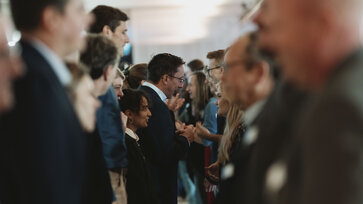
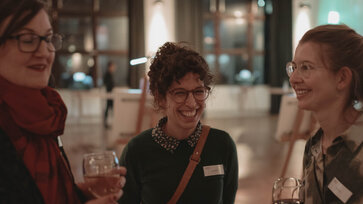
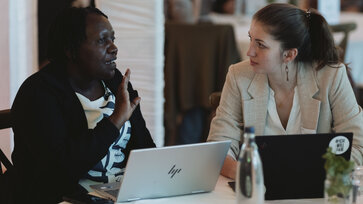
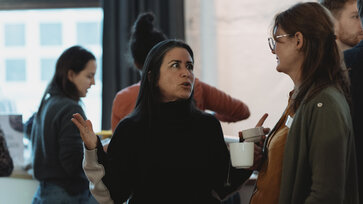
Sustainable agricultural supply chains are a key lever for achieving the Sustainable Development Goals (SDGs), which provide a global framework for how we want to produce, trade and consume food and other agricultural commodities. Sustainably designed supply chains can reduce poverty (SDG 1), combat hunger (SDG 2), promote decent work (SDG 8), establish responsible consumption and production patterns (SDG 12),protect the climate (SDG 13) and biodiversity (SDG 15). Hence, there are many reasons for the various stakeholders, producers and traders to work together. Last but not least, SDG 17 emphasises partnerships for the goals. However, teamwork requires getting to know each other, which is initiated by five minutes of networking. In Berlin's Loewe Saal, the participants stand facing each other in two rows and quickly begin to exchange ideas. A babble of voices rises along the 28 columns in the building: ‘The bananas look good, but the leaves have black stripes,’ ‘The disease is called Sigatoca, the fungi attack the leaves and the plants bear significantly less fruit,’ ‘The climate favours infections,’ ‘How are retailers responding to this?’ After three rounds of five minutes each, the moderator has a hard time ending the discussions and redirecting the participants' attention back to the stage. ‘I feel like the singer of the band “Police”,’ he jokes into the microphone, ‘so lonely!’
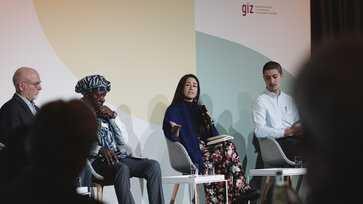
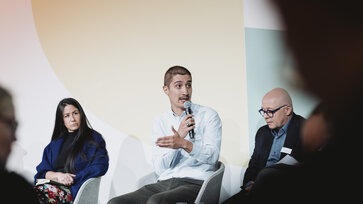
But now, the focus shifts to the next panel on innovative solutions for improved production systems. ‘There is still a very uneven distribution of risk,’ notes Ashlee Tuttleman of the VOCAL network, a coalition of various NGOs, with regard to the many smallhold farmers. ‘Producers must be directly involved in order to achieve systemic change.’ Sascha Tischer also points out that there is still a lot of work ahead for the panelists and the rest of the participants: ‘Of the approximately five million smallholders in the palm oil sector, for example, only 180,000 are currently certified,’ says the vice-chairman of FONAP. ‘Enormous efforts are still needed. We are still too preoccupied with just being “compliant”. But we need more participatory and inclusive design on both sides of the supply chain, and we need to do it together.’ Federico Ceballos from the Centre for Tropical Agriculture (CIAT) offers an optimistic outlook: ’For ten years, I have been observing a change in mentality among farmers, who are becoming increasingly engaged in sustainability.’ Piet van Asten from Olam Food Ingredients adds a consumer perspective: ’And we need customers who want to be part of this journey.’

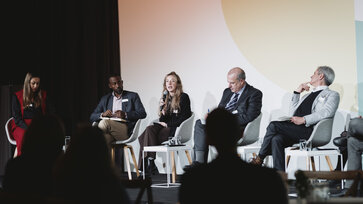
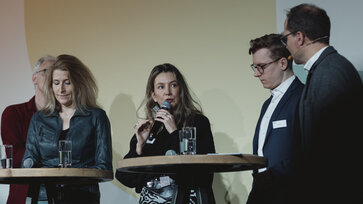
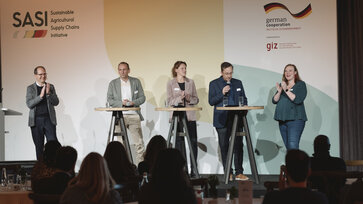
The last panel of the day; from the left: Celeste Fumagalli, Gilbert Gatali, Lena Schweighöfer, Leonard Mizzi, Paul Garaycochea, Lisa Kirfel-Rühle and moderator Christian Thorun
So, producers and buyers are increasingly reflecting on their roles in the development of sustainable supply chains. Both groups also turn their head to the politic realm, which is the topic of the third day's panel. The reason for that, politics can shape the process through national and international legislation. ‘The EU regulation for deforestation-free products (EUDR) is a landmark,’ says Paul Garaycochea, Head of Division Sustainable Supply Chains; Agriculture and Food Systems at the BMZ. Brussels is debating whether to postpone the regulation for a year and to change it. ’Now we have to show that there is no contradiction between sustainability and competitiveness,’ says Garaycochea confidently. Next to him, Leonard Mizzi looks serious. ’There are fears in the markets,’ begins the Head of Unit for Sustainable Agriculture and Food Systems at the EU Commission. ’There is uncertainty because of tariffs and more temptation for hardcore competition and less focus on social and environmental aspects,’ he says, outlining the current political situation in the world. ‘We need to develop Team Europe dynamics and continue to move forward with the SAFE project despite the political and regulatory uncertainties,’ he calls for solidarity, earning applause from the room. Celeste Fumagalli from the International Women's Coffee Alliance encourages hope. ‘Preparing for the EUDR is an opportunity for women. Solutions must be designed from the bottom up,’ says the representative of the organisation for more sustainable incomes for women coffee farmers, ‘and the key is training for women farmers.’ Lena Schweighöfer from the coffee company Tchibo adds: ‘There are many middlemen and traders who need to be involved.’ None of this is perfect yet, ’but progress has been made in recent years’. Paul Garaycochea from the BMZ emphasises with regard to the EUDR: ‘We are not inventing anything new. It is not a threat, but an opportunity.’ Gilbert Gatali from the African Fine Coffee Association (AFCA) soberly summarises: ‘None of this means anything if it doesn't end with more money in the pockets of smallholder farmers.’
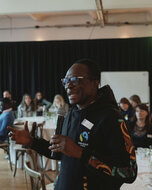
Baaman Chatin
Baaman Chatin, Business Development Advisor at Fairtrade Africa, reflects on the first day.
What is your impression so far?
Baaman Chatin: We are sharing, nobody is withholding the learning – this is a great platform. It is an advantage when the best practices spread.
Did you learn something new at the meeting today?
I got acquainted with a project where they help young drunkards. This is mind blowing because the guys are found everywhere in our communities. In the project, they are counseled and then employed gainfully. Instead of throwing our hands in despair, we should rather look at the positive. I am encouraged. I will try to integrate these vulnerable in our work. They have very good resources. When we turn around their fortunes, we can tap the best from them.
You work at Fairtrade Africa. Do you consider yourself being one of the front runners concerning sustainable supply chains?
Like Fairtrade Africa, all partners here have a vision. When we encourage each other, I believe that we shall get there. So, no one is slow. This is not a race, but it’s a very healthy competition.
What do you say about the speed of the EU legislation process?
EUDR is a very good concept, and there are a lot of engagements going on, there is back and forth. I welcome that because it will fine-tune the whole concept to the best of implementation. If we rush over it, we may not get the best of benefit.
The next day, the stakeholders gather again in the brick building of the Loewe-Höfe, which formerly housed a machine factory and is now a symbol of the transformation of the Moabit district. In the course of the industrialisation, the former agricultural district experienced rapid population growth, which was accompanied by social conflicts over living and working conditions. Even today, the neighbourhood is still caught between prosperity and precariousness, and thereby symbolises the focus of the event: agricultural supply chains. The first panel of the day deals with the systemic change which was evoked the day before and with taking responsibility in procurement practices. ‘We promote minimum wages in our partner countries,’ says Felix Strauß from Aldi Süd Holding, who represents the banana project of the German Retail Working Group on Living Wages and Incomes on the panel. ‘This was well received by our partners.’ The results are shorter price negotiations and easier planning. Aldo Cristiano adds that purchasing is part of a ‘game changer.’ However, the chairman of the Forum for Sustainable Cocoa also emphasises: ‘A mix of support is needed.’ We must ask ourselves how we can support public policy. ‘Investments in infrastructure are fundamental,’ he cites as an example. ‘Purchasing is not everything.’ In contrast, Matthias Fiedler from the Fair Trade Forum points out: ‘A mix of support works if there is a real roadmap for a better life.’ Currently, many producers do not receive sufficient wages for their work. ‘The key question is: How much power would the industry relinquish? How much power would go to the producers?’
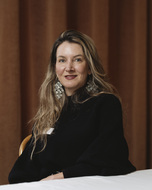
Carolina Jaramillo Ferrer
Following this lively discussion, panelist Carolina Ferrer from the Uniban Foundation provides further insights into the work on responsible procurement practices.
Many perspectives come together here, don’t they?
I see a lot of common ground. In the Global South, we face similar challenges, even if our countries differ. This space allows us to build a bridge between buyers and producers. It’s crucial that our voices are heard because the realities on the ground can be very different from what is often imagined.
What do you mean by that?
Sometimes Europe’s vision of the Global South can be somewhat romanticized. Ideas may seem perfect in theory, but when applied to the realities we face, they often require adjustments. That’s why we believe it’s important to be consulted. SASI provides an excellent platform for this dialogue.
What is your message?
When we talk about sustainability, we often focus on two pillars: social and environmental. But we cannot overlook the third pillar—economic sustainability. For producers, this is a business, and without economic viability, the other pillars cannot stand.
Do you see progress?
Fair pricing is important, but lasting impact requires structural change. Living wages and incomes depend not only on better purchasing practices, but also on strong local institutions, social dialogue, producer empowerment, and policies that shift power toward those at the start of the value chain.
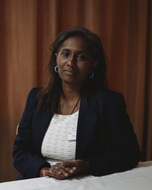
Sheila Senathirajah
During the break, Sheila Senathirajah gets herself a glass of water. She has been following the debate on the role of buyers with rapt attention – she works on living income issues at the ISEAL Alliance.
What is your impression of purchasing practices?
Sheila Senathirajah: There is a lot of discussion around the need of alignment, and we recognize this. However - now is the time to make bigger changes. We need to focus on what really gets us to scale.
What do you suggest?
There is a lot of work in silos still. It is also hard for people to come together. I really like the question on how can we get cross-commodities thinking? There is a need for more sharing. That’s where SASI can really play a strong role: A farmer is a farmer. He’s not a cocoa farmer. He’s not a coffee farmer. He’s a farmer. There is a lot of possibilities for SASI to play a good binder for the different initiatives.
Do you support the idea of establishing a new working group?
I wouldn’t say we necessarily need a new one. It would be good to see what is existing and build from that, but making sure that the right groups are together. Amalgamating is probably the best way to do it. Companies and producers need their own safe space. Creating another one just creates a bit more of an administrative burden for everyone.
There is a lot of talk about level playing field. Do you see it?
We all want that, but how willing are people to compromise and let go of their privileged position?
What does it mean for you?
For me, it's when value is equally distributed across the supply chain. But there is still a lack of accountability on the risk- and the farmer continues to carry a lot of this risk.
Do you miss conversation about it?
Well, I represent the Living Income Community of Practise, and we need to get more into the details: It’s not just about meeting the living income or paying more to enable a living income- how do we go beyond that? How can a farmer feel confident enough to reinvest in his farm confidently?
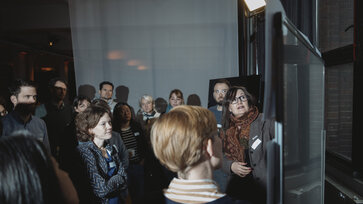
After the first networking break, participants can take a tour to learn about existing projects with great appeal. At five stations, information is presented on the GIZ Due Diligence Fund (‘Companies which analyse their risks in dialogue with their suppliers and those potentially affected are off to a good start’), coffee cultivation in the mountains of Colombia (‘An alternative to drug cultivation and also to animal husbandry’) and sustainable pepper harvesting in Indonesia (‘Monoculture becomes agroforestry’). The important skill, as the people in the Loewe Hall agree, lies in mutually reinforcing all these projects. With this conviction in mind, working groups are formed in the third session of the day. An excellent opportunity for participants to get a feeling for working together, to exchange ideas on living wages, regenerative agriculture and gender equality issues – and to initiate new partnerships.
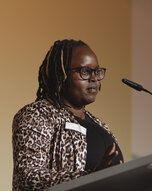
Mary Karanu
Mary Karanu steps on the podium to deliver her keynote speech on the transformation of agricultural and food systems, which concludes the event. Looking at the current situation, there are many negative developments. The goal of Zero Hunger by 2030 has become unrealistic. Climate change, conflicts and inflation as well as weakened international cooperation, are putting pressure on supply chains. Therefore, it is even more important for her to remind us of what is non-negotiable. ‘Access to food is a human right,’ says the ambassador of the Partners4Change (P4C) initiative, who has travelled from Kenya. ‘And it must be in dignity.’ Food and agricultural systems must be viewed as a whole, and citizen participation is of fundamental importance. Because ‘everyone involved benefits from this,’ Mary Karanu concludes this year's stakeholder meeting. And indeed, as has become clear over the last two days, the participants of the event have no interest in bowing to negative trends. The achievements so far are too great and the existing potential is too motivating for that. Optimism for change is spreading. SASI, as this meeting has shown, is right at the heart of it.
A short recap video of the Stakeholder Meeting is available here
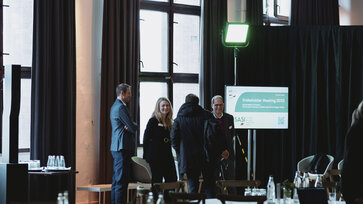





©GIZ/Marcel Maffei