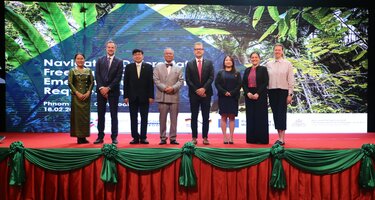
Navigating Deforestation-Free Value Chains: FIT for FAIR launches in Cambodia
With broad participation from government, the private sector and civil society, FIT for FAIR was officially launched in Cambodia. The workshop provided practical insights into the requirements of the EU Deforestation Regulation (EUDR) and the Corporate Sustainability Due Diligence Directive (CSDDD), while strengthening dialogue on deforestation-free value chains and corporate due diligence.
How can Cambodia strategically prepare for the EU’s new requirements on deforestation-free and responsible value chains? This guiding question framed the event “Navigating Deforestation-Free Value Chains and Emerging Due Diligence Requirements”, held on 18 February 2026 in Phnom Penh. The event also marked the official launch of FIT for FAIR in Cambodia – a flagship initiative under the Team Europe Initiative on deforestation-free value chains.
The exchange was jointly organised by EuroCham Cambodia and International Trade Centre (ITC), in close coordination with the Delegation of the European Union to Cambodia. Around 80 representatives from government institutions, the private sector, certification bodies and civil society took part.
Not for the EU – but for Cambodia


In his welcoming remarks, H.E. Dr Sok Siphana, Senior Minister for Special Missions and Chairman of the Trade Policy Advisory Board (TPAB), set a clear tone: “When we try to save the planet, we don't do it for the EU, but for ourselves (…)." He stressed that Cambodia has an opportunity to demonstrate that sustainable production and export competitiveness can go hand in hand: “We have to make sure our rubber is deforestation-free (…). Cambodia has the opportunity to show that sustainable production and export competitiveness can go hand in hand."
Mr Koen Everaert, Deputy Head of Cooperation at the EU Delegation to Cambodia, underlined that while the EUDR introduces new requirements, it also creates incentives for higher standards, improved traceability and stronger competitiveness. He emphasised that under the EU’s Global Gateway strategy, the EU is deepening its partnership with the private sector through technical assistance, capacity building and improved traceability systems, in order to prepare Cambodian companies for increasing due diligence obligations and to strengthen their integration into sustainable global value chains.
The message was clear: EUDR readiness is not merely about regulatory compliance. It is about national responsibility, long-term competitiveness and sustainable development. The event focused in particular on the palm oil, natural rubber and timber sectors.
From requirements to practical steps
Mr Mathieu Lamolle, Senior Adviser at the International Trade Centre (ITC), delivered a detailed introduction to the objectives, scope and timeline of the EUDR. He outlined the specific due diligence obligations for relevant stakeholders and explained the practical implications for Cambodian exporters and other actors along the value chain. The session concluded with an extensive Q&A addressing operational challenges in implementation.
Step by step, participants explored what EUDR readiness entails in practice: from legality documentation and record-keeping requirements to geolocation data, risk assessment and risk mitigation measures.
In addition to the EUDR, the workshop also examined the requirements of the CSDDD, particularly with regard to human rights due diligence across global value chains. This highlighted that the discussion goes beyond environmental criteria and extends to comprehensive corporate responsibility.
Private sector contributions demonstrated that some companies have already begun developing traceability systems and sustainable sourcing approaches. At the same time, breakout discussions provided space for open exchange on challenges and opportunities, including costs, data availability, governance issues and the inclusion of smallholders.
A recurring theme was the need to align economic viability with environmental protection. As H.E. Dr Sok Siphana emphasised: “We have to make sure our rubber is deforestation-free. We have to make sure we don't make money on one side and lose it on the other side at the expense of our biodiversity and climate."
From dialogue to operationalisation
As the local host organisation, EuroCham Cambodia will now establish working groups to accompany the ongoing status quo and gap analysis and, building on this, to develop concrete policy recommendations.
H.E. Dr Sok Siphana concluded with a clear call to action: “Now it is time to roll up our sleeves and get to work!"
With the launch of FIT for FAIR, a coordinated and participatory process has begun to systematically strengthen the preparedness of Cambodian stakeholders for evolving EU requirements – through dialogue, technical support and joint solutions across the entire value chain.
For further reading, see:
Press Release EuroCham Cambosia: Navigating Deforestation-Free Value Chains: EuroCham Cambodia Hosts Workshop on EU Due Diligence Re…
The Phnom Penh Post: EU deforestation regulations seen as opportunity for Kingdom’s exporters | The Phnom Penh Post