Closing the Living Income Gap in Cameroon with Biochar
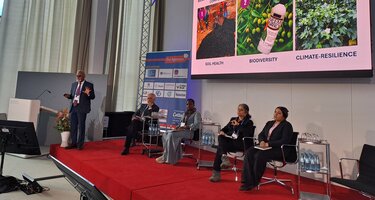
How can smallholder farmers in Cameroon achieve a living income? At the 38th International Bremen Cotton Conference, the project Sustainable Cotton – Innovations for Strengthening Climate Resilience, implemented under the Fund for the Promotion of Innovation in Agriculture (i4Ag), demonstrated how biochar can serve as a scalable solution to boost incomes whilst simultaneously enhancing climate resilience.

The 38th International Cotton Conference Bremen (25–27 March 2026) provided a key platform for discussion on current challenges and potential solutions in the global cotton sector. In this context, the project’s results were presented in two separate sessions. In the session “Cotton Production in the Regions,” Dr. Keshav Kranthi from the International Cotton Advisory Committee (ICAC) presented the key findings. These results were explored further in a technical seminar on Living Income in Cameroon, which focused on practical approaches and concrete solutions.
The project is being implemented jointly with ICAC, the Centre de coopération Internationale en Recherche Agronomique pour le Développement (CIRAD), the Cameroonian research institute IRAD, and the cotton company SODECOTON—a partnership that combines international expertise with strong local grounding.
Biochar as a Key Innovation
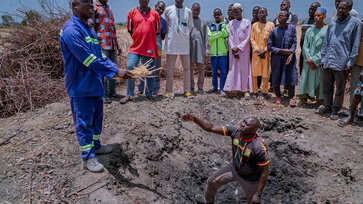
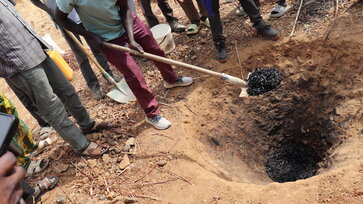
Enriched biochar is produced from cotton stalks - agricultural residues that are often burned in the fields. The stalks are heated under controlled conditions with a limited supply of oxygen, resulting in a porous material. This improves soil health and increases the soil’s capacity to retain water and nutrients. When combined with organic additives such as Bokashi or Jeevamrit, it becomes an effective fertilizer that reduces dependence on mineral inputs.
Biochar to Reduce the Living Income Gap
In northern Cameroon’s cotton sector, the income of many households remains well below a living income. The seminar, moderated by Roger Peltzer (Pro Smallholder Farmers Africa e.V.), highlighted the scale of the challenge: according to a study presented by SODECOTON, the average living income gap is around 46 %.
However, the presented findings also show the potential of biochar: average yield increases of about 40 % - and even over 100 % for 12 % of producers - as well as additional income of more than EUR 300 per hectare per year are achievable. At the same time, production costs - especially for mineral fertilizers - can be reduced by around EUR 100 per hectare per year. This is a decisive advantage, particularly against the backdrop of rising fertilizer prices.
Added Value for Climate and Resources
Using cotton residues as a raw material offers multiple benefits: rather than being burned, they are returned to the agricultural cycle. This reduces CO₂ emissions, improves resource efficiency and strengthens the economic stability of farms. At the same time, biochar contributes to long-term carbon sequestration in the soil and increases resilience to climatic changes.
In combination with new financing approaches, this opens up additional opportunities: together with bizpando AG, efforts are underway to generate further income streams through carbon credits, thus enhancing the economic benefits for producers.
The conference made it clear: innovative, practical solutions to improve incomes and climate resilience are available. The task now is to disseminate these in a targeted manner, integrate them into existing structures and scale them along the value chain - in Cameroon and beyond.
More Information
More information on our Biochar project is available in our accompanying articles:
What used to be burned now protects against drought and secures income – SASI
From Knowledge to Credits: Scaling Climate-Smart Cotton Production – SASI
Additionally, our project video shares valuable insights:
Coton et changement climatique: le pari durable du Biochar au Cameroun