From Vulnerability to Resilience: Ghana Prepares Farmers for Climate-Smart Cocoa Production
Ghana's cocoa sector is under pressure: climate change is threatening harvests, incomes, and entire livelihoods. But with innovative training programs, the country is preparing its cocoa farmers for the cocoa cultivation of the future.
Ghana’s cocoa sector long considered the backbone of rural livelihoods and a pillar of the national economy has faced a worrying decline in productivity in recent years. Among the most pressing drivers of this downward trend is climate change, which continues to unleash unpredictable rainfall patterns, rising temperatures, pests, and diseases that threaten cocoa farms across the country. To meet this challenge head-on, extension services have become more critical than ever, ensuring that farmers are not only informed about the risks but also equipped with the tools and knowledge needed to adapt and thrive. The Cocoa Health and Extension Division of COCOBOD (CHED) remains at the forefront of this national effort, delivering targeted, hands-on support to farmers through training, advisory services, and community engagement.
Among the Cocoa Health and Extension Division most transformative interventions is the Farmer Business School (FBS), an innovative training model that strengthens farmers’ entrepreneurial thinking, business orientation, and decision-making skills. To help farmers build resilience in an era of climate volatility, the Cocoa Health and Extension Division has upgraded the Farmer Business School training guides to feature climate-smart agricultural concepts, equipping farmers with practical strategies for mitigation and adaptation.
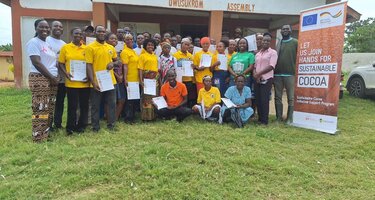
In view of this, the GIZ-Sustainable Cocoa Programme (SCP), in close collaboration with theCocoa Health and Extension Division, organized a two-week pilot training and field testing of the new Climate-Smart Farmer Business School guides with two cocoa farmer cooperatives in Sunyani and Tafo districts. This hands-on exercise provided invaluable insights into:
The practicality of the new modules
The relevance of the climate-smart content to everyday farm realities
The user-friendliness of the materials for both trainers and farmers
The feedback gathered will now help refine and fine-tune the training content ahead of the nationwide rollout.
Climate smart knowledge for more resilience in cocoa farming


This pilot is more than just a test; it marks a crucial step toward strengthening Ghana’s cocoa landscape for the long term. By integrating climate-smart knowledge with strong business skills, farmers will be better equipped to improve yields, protect their farms, and build stable incomes despite the changing climate. The Cocoa Health and Extension Division and GIZ-SCP teams will continue working together to enrich the training materials to enhance farmer productivity while ensuring environmental sustainability. As Ghana strengthens the capacity of its cocoa farmers, it is also strengthening the foundation of a more resilient, eco-conscious, and business-minded cocoa sector a sector ready to adapt, innovate, and thrive no matter what the climate brings.
A climate-smart future for cocoa begins with informed, empowered farmers and Ghana is taking decisive steps to make that future a reality.
This initiative is part of the Sustainable Cocoa Programme, funded by the European Union and the Federal Ministry for Economic Cooperation and Development (BMZ), implemented by Deutsche Gesellschaft für Internationale Zusammenarbeit (GIZ) GmbH in cooperation with Ghana Cocoa Board (COCOBOD).