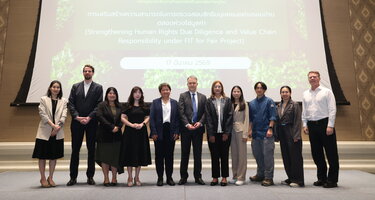
Enabling framework conditions for EU due diligence: FIT for FAIR brings stakeholders together in Thailand
Where does Thailand stand in creating enabling framework conditions for relevant stakeholders to comply with European due diligence legislation – and where do gaps remain? With this guiding question, representatives from government, the private sector, academia and civil society came together in Bangkok as part of FIT for FAIR. The focus was on traceability, deforestation and human rights in the rubber, timber and palm oil sectors, as well as a joint analysis of the status quo and existing needs for action.

FIT for FAIR – a flagship of the Team Europe Initiative on deforestation-free value chains – successfully continued its support for key stakeholders in Thailand’s rubber, timber and palm oil sectors in February and March 2026. Around 80 representatives from government, the private sector, academia and civil society came together in Bangkok for three working group meetings on 19–20 February and 17 March. The workshops were organised by the local implementing partner, the Thailand Environment Institute (TEI).
The aim was to deepen understanding of the European due diligence legislation EUDR and CSDDD, jointly analyse challenges, and develop concrete approaches to solutions – as a basis for subsequent policy recommendations.
Focus on traceability, deforestation and data availability
The first two meetings focused on traceability and deforestation. Experts Dr Theeraya Mayakul and Sopon Naruchaikusol presented the legal requirements and the initial findings of the status quo analysis.
It quickly became clear that without standardised and accessible data systems, as well as improved coordination between civil society, agricultural, private sector and government actors, it will be difficult to create enabling conditions. At the same time, participants emphasised that smallholders need to be specifically supported to secure their market access and meet sustainable production requirements.
Human rights as a core element of due diligence


The working group meeting on 17 March placed human rights due diligence at the centre of discussions. Under the guidance of expert Dr Chomkate Ngamkaiwan, participants engaged with key human rights issues, including child labour and forced labour, the position of women, fair wages and incomes, and the rights of migrant seasonal workers.
Through exchange between the different stakeholder groups, practical approaches were developed on how to better operationalise these requirements along value chains.
National contributions to European requirements
A key takeaway from the discussions: while the legal responsibility under the EUDR and CSDDD lies with companies placing relevant products on the European market or falling within the scope of the respective legislation, effective implementation can only be achieved in close cooperation with producer countries such as Thailand. These countries provide the foundation for sustainable and transparent value chains and help establish the necessary enabling framework conditions.
For national stakeholders, this also represents an opportunity: those who engage proactively can not only contribute to operationalisation, but also strengthen competitiveness and secure market access.
Next step: from analysis to policy recommendations
The results of the working group meetings will be further systematised in a Policy Lab in April and subsequently refined and validated through public consultations. The aim is to develop concrete policy recommendations to be presented to policymakers at the end of May.
Further insights are available in the publication by the Thailand Environment Institute: