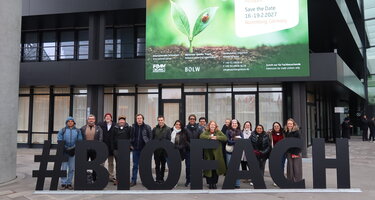
Brazilian delegation visits BioFach: An insight into the European organic market
Organic products are booming in Europe. This presents new opportunities for sustainable products from Brazil. A delegation accompanied by SASI has visited the BioFach fair in Nuremberg to explore market opportunities, certification schemes and new partnerships.
The European market for organic products has been growing for years. In Germany alone, consumers bought more organic food in 2025 than ever before. With a turnover of 18.7 billion euros in 2025, the organic sector is thus growing significantly faster than the German food market as a whole. Domestic production cannot keep pace with this rising demand. This opens up opportunities for foreign producers to meet the rising demand or enter the market with new products. In February, representatives from SASI and a Brazilian delegation comprised of two projects promoting sustainable agriculture attended the BioFach trade fair in Nuremberg to explore new opportunities and familiarise themselves with the European organic market.
The delegation, included cotton farmers, rubber tappers and representatives of local cooperatives and NGOs. It gained a comprehensive insight into the European and global organic market through their participation in BioFach, the world’s largest trade fair for organic products. To this end, SASI organised targeted meetings with potential business and project partners, tailored to the delegation’s needs. This enabled participants to establish new partnerships and deepen their knowledge of European organic certification and market access requirements. At the fair, the delegation met numerous stakeholders across the organic value chain. In discussions with companies, certification bodies and market initiatives, the participants gained valuable insights into market trends, quality requirements and potential forms of cooperation.
Discussions along the organic value chain
One meeting was organized with the Sourcing + Markets Department of the Import Promotion Desk. The focus was on opportunities for new partnerships and prospects for Brazilian products gaining access to the European market. A discussion with representatives from Naturland – Verband für ökologischen Landbau e.V. outlined the differences between European organic certification and Naturland certification. The latter includes social criteria, long-term trade relationships and the protection of biodiversity – for example, by avoiding monocultures. The Brazilian partners held further discussions with COPABASE. Here, the delegation was able to exchange experiences with a company from their own country and learn more about the challenges involved in the planned market entry into Europe. At Tradin Organic, a company that trades in organic raw materials worldwide, the focus was particularly on products such as dried fruit and nuts, a product range on which Brazilian small-scale farmers are currently concentrating.
New perspectives on production and marketing
The trip to Nuremberg not only provided participants with professional insights, but also offered them new perspectives on their own production and marketing strategies.

For us it was very important to see the potential and requirements of the European and organic market. We now know the requirements of the European market and are oriented on what other products have good potential.”
The delegation consisted of representatives from various organisations and initiatives in Brazil. The NGO Diaconia supports small-scale farmers in implementing agroecological practices and offers training on cooperation and adaptation to climate change. A key focus is on the organic cultivation of cotton in crop rotation with, for example, peanuts, sesame, etc., in north-eastern Brazil.
The organisation SOS Amazônia develops projects and policy strategies to promote sustainable development, support indigenous communities and protect biodiversity in the Amazon region. Together with the French show brand VEJA, it is implementing the Habitar reforestation project. The aim of the project is to rehabilitate degraded areas of the Amazon rainforest both as habitats for flora and fauna and as a source of income for the local population. In doing so, VEJA supports local rubber tappers in regenerating and sustainably managing forest areas on their land.

During our visit to the Biofach, we observed a range of products that local families are already cultivating across the Amazon, particularly within restoration areas where agroforestry systems have been established. For instance, many of the fruits already cultivated in the region hold commercial potential and can open doors to new markets, including value-added products such as preserves, jams and dehydrated fruits.
The delegation’s visit concluded with a PR event at the VEJA store in Berlin on 12 February. There, the small-scale farmers had the opportunity to take to the stage themselves to talk about their farming techniques, their product range and the challenges posed by their local living and production conditions. At the same time, they explained how the local projects are helping to improve their quality of life and opening up new economic opportunities.