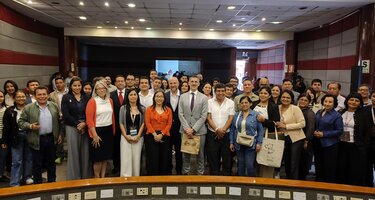
'Beyond Price: Strategies for a Sustainable Income for Producers' - Conference held in Peru
The conference 'Beyond Price: Strategies for a Sustainable Income for Producers' was held on 27 November in Lima, organised by the German Development Cooperation, the NGO Rikolto and the United Nations Development Programme (UNDP). This event marked the launch of the Coffee Symposium activities within the framework of Expocafé 2025 in Peru, the country’s largest national trade fair for the sector.
Coffee is part of the daily life of millions of people around the world. At the same time, it is one of Peru's key economic drivers and the main source of livelihood of thousands of families in rural areas. Peruvian coffee is highly valued internationally, and, in 2024, exports exceeded US$ 1.1 billion. However, a number of challenges prevent producers from earning a decent income, including low productivity, the increasing impacts of climate change, new regulatory requirements, price volatility and weak institutional structure within the Peruvian coffee sector.
Against this backdrop, the conference ‘Beyond Price: Strategies for a Sustainable Income for Producers’ was held on 27 November in Lima, organised by the German Development Cooperation, the NGO Rikolto and the United Nations Development Programme (UNDP). This event marked the launch of the Coffee Symposium activities within the framework of Expocafé 2025, the country’s largest national trade fair for the sector.
The conference provided a platform to discuss the importance of strengthening sectoral coordination in order to address structural barriers and move towards sustainable incomes. During the opening session, Nicole Maldonado, Head of German Development Cooperation at the German Embassy, reaffirmed the commitment to a fair, transparent and deforestation-free value chain. She also highlighted the decisive role of the private sector in a global context characterised by rapid change and limited public resources.
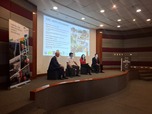
The panel brought together complementary perspectives on pathways towards sustainable incomes. Ricardo Paredes (UNIDO) called for a reassessment of the role of certifications, acknowledging their contribution to improved labour and environmental conditions, while warning that many have lost their transformative potential by becoming mere compliance checklists. Representing the producers' perspective, Pedro Rodríguez (ACPC Pichanaki Cooperative) emphasised the need to professionalise producer organisations and invest in soil restoration. He noted that well-organised producers are increasingly adopting sustainable production models with yields almost double the national average. Björn Willms (GIZ), representing the German Retailers' Working Group on Living Income in the Coffee Sector, stressed the importance of strengthening a shared-responsibility approach that creates clear conditions for achieving living incomes, supported by responsible purchasing practices and transparent traceability systems. The panel was moderated by Mariela Wismann (Rikolto), who underlined the importance of fostering dialogue spaces that enable coordination, build trust and generate effective solutions to address the sector’s complex challenges.
The dialogue marked the beginning of a structured dialogue programme planned for 2026 and 2027, aimed at continuing to build consensus and developing strategic actions to improve the living conditions of coffee producers across the country.

Presenters from the German Embassy, Belgian Embassy, UNDP, Rikolto, UNIDO, ACPC Pichanaki, Peruvian Coffee and Cocoa Chamber and GIZ