Reducing Post-Harvest Losses and Utilizing Agricultural Residues
The project supports farmers in reducing post-harvest losses and sustainably increasing their income across two key agricultural value chains.
The project at glance


Project Implementation
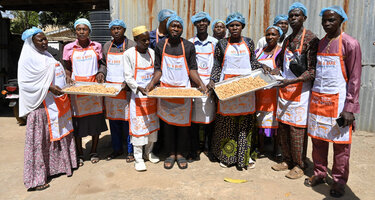
In Ghana and Kenya, the project focuses on the grain value chain. However, the measures developed are not limited to grain; they are also applicable to pulses and other commodities that are stored in bags. The objective is to strengthen both farmers’ incomes and the health of local communities through improved post-harvest management. In collaboration with the private-sector partner Saving Grains 301 GmbH, the project has introduced hermetic storage solutions, modern moisture measurement technologies, and an innovative grain dryer. In addition, Saving Grains offers a novel business model in which grain is purchased after harvest, securely stored, and sold at a later point in time when market prices are higher. A digital tracking tool ensures transparency, and the resulting profits are shared fairly with farmers.
In Nigeria, the project works with the partner organizations Agridrive Ltd. and the African Agricultural Technology Foundation (AATF) along the cassava value chain. The core focus is the introduction of an innovative processing technology that replaces manual peeling and reduces processing waste to less than one percent. Through this holistic processing approach, two marketable products are generated: a high-quality cassava flour (HQCF) for human consumption and a flour with a higher peel content (HQCP) that can be used as animal feed. In addition, farmers receive training in good agricultural practices (GAP), mechanization, and post-harvest management. At the same time, local micro and small entrepreneurs acquire the know-how to further process cassava flour and to successfully engage in entrepreneurial activities along the value chain. As a result, higher-quality products, increased incomes, and a more resilient local food system are created.
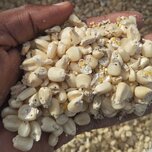
“We used to store grains in jute bags and lost almost half by the next season. Now our maize looks fresh after months.”
Hawa Danaa, leader of the Baaladau Women’s Group in the Upper West Region, Ghana
Project Partner
Grains Value Chain:
Saving Grains 301GmbH is a German social enterprise that works with smallholder farmers in Ghana and Kenya to reduce post-harvest losses, access financing, and connect with local and global markets. The company provides innovative storage solutions, digital tracking tools, and advisory services to help farmers store and sell their crops at optimal times, increasing their incomes and strengthening resilient agricultural value chains.
Cassava Value Chain:
The African Agricultural Technology Foundation (AATF), established in 2003, is an African-led, not-for-profit organization that facilitates access to and adoption of agricultural technologies by smallholder farmers in sub-Saharan Africa. Its mission is to enhance agricultural productivity and contribute to a prosperous, resilient, and food-secure Africa through innovative farming solutions.
CLAYUCA Corporation is a Colombia-based, not-for-profit organization that promotes technological innovation and agro-industrial development of cassava and other tropical roots and tubers through modern technology transfer and capacity-building in tropical regions.
Agridrive Ltd. is an agritech company operating in Nigeria and Kenya that helps farmers access modern mechanization, digital agriculture tools, and value chain services. Its mission is to unlock agribusiness opportunities across sub-Saharan Africa by providing a range of solutions, from farm inputs and mechanization to advisory services, processing, and market linkages.
What has been achieved so far?
So far, approximately 24,500 farmers, more than half of them women, have received training in good agricultural practices, mechanisation, post-harvest management or processing. These trainings have contributed to a reduction of post-harvest losses in the grain value chain by 17.5% in Ghana and Kenya.
In addition, over 1,900 smallholder farmershave received profit-sharing benefits, increasing their income. Innovative technologies have also been introduced: the first cassava processing machine is now running in Nigeria and has processed around 50 tons of cassava into HQCF, which has been successfully marketed, a biomass dryer has been installed in Kenya, and the low-cost, low-tech DryCard™ for grain moisture measurement has been tested and calibrated for use with rice.
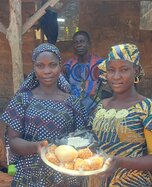
“Before the training, we processed cassava only for home use. Now local hotels here call us to supply odourless fufu because of the quality.’’
Adewale Kemi and Olaniyi Rebecah, Cassava farmers in Oyo State, Nigeria
Future Prospects
In the next project phase, training activities in Nigeria will be expanded to reach the target of a total of 6.000 farmers receiving mechanisation services. In addition, two more cassava processing machines will be installed in cooperatives, and different business models will be piloted. In Ghana and Kenya, further farmers are planned to be mobilised to register in the Saving Grains App so that they can benefit from profit-sharing.