Innovations for agricultural supply chains – ideas from the field for the future
New challenges call for new ideas: In a world, that is constantly changing, we need creative approaches to deal with the new overall conditions. In the agricultural and food industry, the decisive impulses come from where crops are sown, harvested, and produced. With the Sustainable Agricultural Supply Chains Initiative (SASI), we promote such innovations, because their far-reaching impact makes them indispensable in the fight against climate change and poverty, and for the preservation of biodiversity, social justice, and a secure supply of raw materials – in Germany, Europe, and all over the world.
Progress that resonates – worldwide
Global agricultural supply chains connect millions of people – from smallholder farmers and local producers to international companies and consumers. However, many chains are vulnerable: climate change, soil degradation, plant diseases, and unfair market conditions threaten incomes, security of supply, and biodiversity. This is where we take action. With our innovations, we make the cultivation of selected raw materials climate resilient, we protect resources, and we strengthen social justice.
A win-win situation for all involved: In Germany and Europe, companies and consumers are reliably supplied with agricultural products by ensuring global supply chains and stable trade relations. Local smallholders and their families benefit economically, ecologically, and socially in the long term. Also, nature is protected by higher environmental standards along agricultural supply chains.
Innovation as a driver for sustainable agricultural supply chains
We promote ideas, technologies, and partnerships that strengthen smallholder farms, protect natural resources, and advance climate-friendly production methods. In doing so, we ensure that innovations are implemented effectively and, ideally, can be rolled out broadly and on a long-term basis. We identify promising solutions, support their development and dissemination, and connect innovators with partners from research, the business sector, politics, and the civil society. This results in self-sustaining strategies with a clear focus: sustainable, gender-equitable, and climate-friendly innovations for fair, green and inclusive agricultural supply chains take centre stage.
One of the key areas of our work is capacity building: trainings, workshops and learning platforms impart practical knowledge, promote the exchange of experience, and empower in particular women and young people to actively implement sustainable solutions. In this way, we strengthen local knowledge carriers and make innovations effective, thus creating agricultural supply chains that are ecologically sustainable, economically efficient, and socially equitable.
Innovations become palpable, skills grow, and supply chains evolve into vibrant networks that promote climate resilience, the conservation of resources, and fair participation – a win on a global scale for everyone involved.

Rice: Climate-friendly and future-proof
The innovative Carbon Offsetting Rice Emissions (CORE) project focuses on climate-sensitive rice cultivation in India and Nigeria. Together with smallholder farmers, we develop farming methods that significantly reduce greenhouse gas emissions while improving quality of life and income. New technologies and processes make it possible to certify emission savings as tradable carbon credits – an important step towards climate-friendly supply chains. By 2027, the goal is to train 30,000 farmers, save 150,000 tons of CO₂ equivalents, and empower 5,500 women in leadership and entrepreneurial skills. This makes rice an example of sustainable change and more resilient agricultural and food systems.
Cocoa: Transparency strengthens the market position
With the digital solution Open Cocoa Chain, we are creating greater transparency along the cocoa supply chain – thereby supporting producers who use climate-friendly, deforestation-free cultivation methods. Our open blockchain solution makes it possible to clearly trace the origin of every cocoa bean: smallholders enter their data into the blockchain via the MiCacao app, where it becomes visible to buyers. This allows them to demonstrate the added value of their sustainable cultivation. Furthermore, the MiCacao Farmer Wallet enables producers to manage data on their operations and sustainable production as verifiable digital assets, allowing them to decide for themselves which supply chain actors they want to share this information with. This improves the market position of producers and creates incentives for the long-term use of the digital solution. At the same time, Open Cocoa Chain promotes knowledge transfer on digital traceability and highlights how an interoperable and open-source technology contributes to fairer, sustainable supply chains.
Bananas: Using AI to combat plant diseases
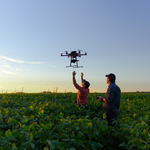
The fungal disease Fusarium TR4 threatens banana plantations around the world – and with it the livelihoods of hundreds of thousands of families, also in Latin America. With ALER4TA, we are utilising digital innovations: drones and remote sensing systems use AI to detect the pathogen at an early stage, while a photo app helps with quick and reliable identification in the field. This enables farmers to act swiftly before the pathogen spreads uncontrollably and entire crops are lost. At the same time, we promote international research into resistant or tolerant varieties and sustainable cultivation methods that strengthen soils and curb the spread of the disease. Much of the more than 1 million hectares of banana and plantain growing areas in the Andean region of South America are already being monitored – an important step towards resilient and sustainable banana supply chains.
Shrimps: Sustainable aquaculture
In Vietnam, we promote innovations for environmentally friendly shrimp production. By introducing recirculation systems and better water management, we are reducing the application of chemicals, using resources more efficiently and reducing wastewater and sewage sludge by up to 90%. At the same time, we support smallholder farmers in mangrove shrimp farms in increasing their production and complying with international sustainability standards. In this way, we ensure stable yields, protect mangrove forests, and create future prospects for coastal communities in the Mekong Delta.
Cotton: Resilient plants, healthy soils
In Cameroon, we support cotton farmers in combating climate change through innovation. New, resilient varieties withstand heat and disease, while plant biopesticides encapsulated in nanoparticles and thus UV-stable protect the plants – without any harmful side effects. Cotton stalks and other crop residues are used to produce enriched biochar, which makes soils more fertile and stores water. This increases yields and incomes, while also benefiting the environment and the community. Through training and the promotion of young entrepreneurs, we are strengthening knowledge, climate resilience, and sustainable future prospects in the cotton sector.
Contact
i4Ag
i4Ag@giz.de